
What Treasure?
Narrative, Puzzle, Quest, Technical Design
Open Space Exploration | Landmarks | Natural Guidance
| Environment Puzzle | Combat
The Elder Scrolls V: Skyrim
Level Summary
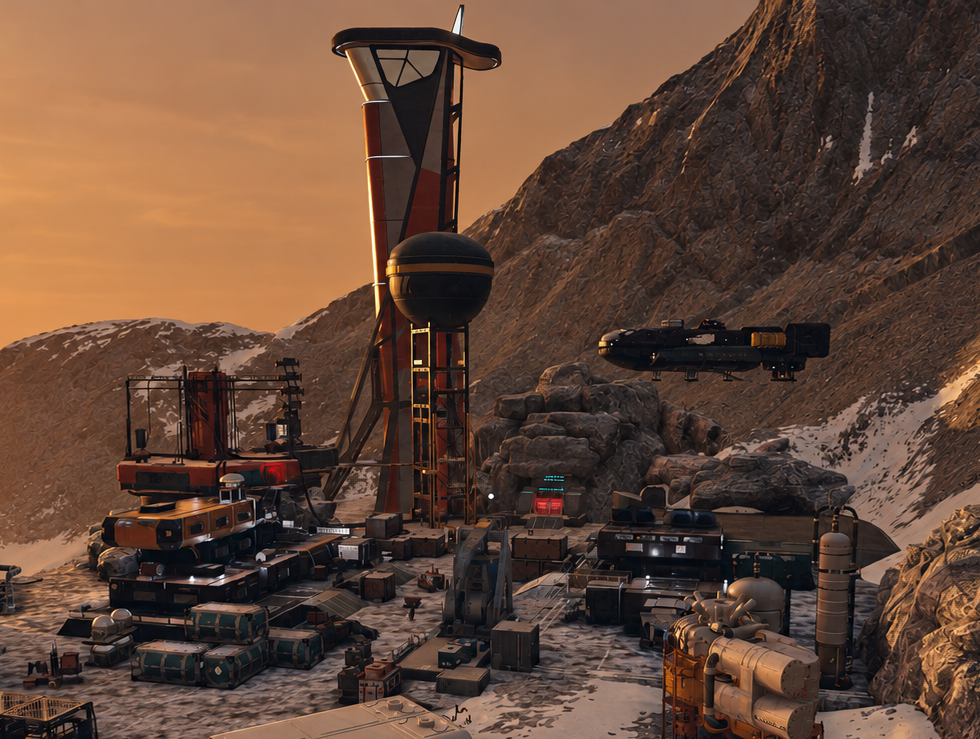
What Treasure? is a single-player narrative quest designed for Starfield. The level combines Puzzle-solving, combat, and dialogue to deliver an interactive story experience. Players must explore a mining facility, gather Power Cells through NPC interaction, environmental challenges, and combat, in order to restore power to the underground Mine and advance the narrative.
25+ minutes of gameplay
1 exterior space
1 interior space
1 main quest
1 side quest
1 morally-grey choice with 2 branching endings
Design Goals
Create a Narrative-Driven Environment with Meaningful Player Choices
The quest was designed to guide players through a layered story involving survival, sacrifice, and moral decisions. One of the main goals was to let players interact with NPCs through dialogue that reflected their decisions and had visible consequences.

Integrate Puzzles with Core Gameplay
A major goal was to utilize the power cell mechanic to link puzzles with narrative and exploration. Players had to find, unlock, and insert cells to restore systems and access new areas, thereby giving the environment functional meaning and reinforcing their role in resolving the crisis.

Balance Exploration, Puzzle Solving, and Combat Across a Large Play Space
To support a 30-minute session, the level combined vertical and horizontal progression across seven Indoor rooms and four Outdoor areas. Exploration and puzzles gradually built tension, leading to a climactic combat encounter.

Narrative Structure - Fishbone Diagram
Using a fishbone diagram helped structure the narrative. I identified the key information each character and stage needed to deliver, then placed it early in dialogue to ensure visibility. This kept conversations focused and made iteration easier.
Narrative Pacing
Each NPC scene conveyed at least one key narrative point. I carefully paced these reveals—too early risked spoiling tension, too late caused confusion. Key lines were kept short, clear, and direct.
Environmental Storytelling
Narrative information was not only delivered through dialogue, but also through the environment. For example, the crashed pirate ship and patrolling enemies near the entrance visually communicated the idea of a recent pirate attack.

The inactive Signal-Shield Tower foreshadowed its plot significance from afar. Later, a confrontation between two NPCs highlighted a values conflict, reinforcing the broader narrative through dialogue and scene composition.

The clinic, the NPC hub inside the Mine, reveals that reactivating the Signal-Shield Tower would expose the camp to harmful radiation. This is conveyed through both dialogue and environmental cues—medical beds, equipment, and NPC behavior. The setting also justifies why power cells are stored there: limited backups are prioritized for critical sites after the outage.

Gameplay Depth / Technical Challenges
This level explored the depth of the power cell mechanic by expanding it beyond the one-time, irreversible battery use seen in the base game. Instead, I created a reusable power cell system that allowed players to insert and remove batteries freely, enabling more dynamic puzzle-solving gameplay.

I redesigned multi-slot battery puzzles to work independently of quest stages, addressing a limitation in the base game and improving replayability. To prevent progression blockers, I added a dual-layer safety system including indicator lights and trigger boxes to ensure puzzle states remained clear and recoverable.

Postmortem
What Went Well?
-
Improving the flow of the level.
-
Getting the battery mechanic to
work smoothly. -
Narratively, I improved the story pacing compared to earlier versions.
What Went Wrong?
-
I didn’t define the core gameplay and flow early in the process.
-
The uncertainty around whether the battery mechanic could be implemented.
-
The pacing of the narrative was also difficult to manage.
-
The space in some rooms was too large and hard to decorate.
What I Learned?
-
I learned the importance of locking down core gameplay mechanics and level flow early in development.
-
In terms of narrative design, I learned that branching dialogue requires a strong structure and clear player intention.
-
I also learned that time management between different parts of the level